

_500x500.jpg)
『Flow Meter for Fire Pump Testing Requirements: NFPA 20 Venturi Pipe Spacing Manual』Related information(v cone flow meter|rotary gas meter|gallon meter|gear meter|metal tube rotameter|glass tube rotameter|nutating disk meter|transit time ultrasonic flow meter|wedge flow meter|pd meters|hydraulic flow meter|ultrasonic water flow meter|water flow meter|air flow meter|magnetic water flow meter|oxygen flow meter|gas flow meter|argon flow meter|air velocity meter|gasoline flow meter|fuel flow meter|ultrasonic water meter|digital water meter|nitrogen flow meter|solid flow meter|Oxygen tank flow meter|digital water flow meter|diesel fuel flow meter|steam flow meter|02 flow meter|compressed air flow meter|oil flow meter|liquid flow meter)
Flow Meter for Fire Pump Testing Requirements: NFPA 20 Venturi Pipe Spacing Manual
Quick Answer: NFPA 20 fire pump tests require a calibrated flow meter on the test loop. If you use a Venturi meter, plan for at least 10 pipe diameters upstream and 5 pipe diameters downstream. Many pump service crews now install an electromagnetic flow meter from Silver Instruments because it needs less straight pipe and can send 4-20 mA HART signals directly to the fire pump controller.
What NFPA 20 Says About Flow Metering
NFPA 20 is the standard for stationary fire pumps. Chapter 14 covers acceptance testing. You test at churn, 100 percent, and 150 percent of rated capacity. Churn means zero flow. The flow meter matters at the 100 percent and 150 percent points. The test loop needs a flow meter that is accurate and repeatable. The standard does not say you must use only a Venturi meter. In practice, pump test skids often use Venturi, electromagnetic, or ultrasonic flow meters. The key point is calibration. A flow meter that drifts during a test will give false pump curve data.
Most engineers skip this part. They focus on pressure and speed. But flow data proves the pump is doing its job. If the meter has poor straight pipe, the readings will jump. This can cause a pump to fail an annual test even when the pump is healthy.
Venturi Pipe Spacing in Fire Pump Test Loops
Venturi meters use differential pressure. They need a stable velocity profile. In a fire pump test line, the common rule is 10D upstream and 5D downstream. D means the inside pipe diameter. For a DN150 test header, that means 1.5 meters of straight pipe before the Venturi and 0.75 meters after. If you have an elbow or tee upstream, add more straight pipe. Some Venturi manuals call for 15D upstream for high beta ratios. Small pipes and high flow rates make this worse.
Here is the thing. Most pump rooms are already tight. You cannot always cut the pipe to add 10D upstream. A Venturi meter can be a poor fit in a small test header. This is why many contractors choose an electromagnetic meter. It needs less room.
We have seen this on customer sites in Malaysia. A pump test trailer had a DN100 Venturi with only 0.5 meters of straight pipe before the meter. The flow reading jumped by 6 percent at 150 percent rated flow. After adding a straightening section, the reading settled. Always check the meter manual. NFPA 20 points to the flow meter installation manual for exact pipe spacing.
Electromagnetic Flow Meter for Fire Pump Testing
Silver Automation Instruments supplies electromagnetic flow meters for fire pump test loops. These meters do not use differential pressure. They measure the velocity of water directly. Accuracy is plus or minus 0.5 percent of reading. Available sizes go from DN15 to DN400. For most fire pump test headers, you need DN100, DN150, or DN200. The sensor liner is PTFE. Electrodes are stainless steel. Outputs include 4-20 mA HART, RS485, and pulse. The sensor can be IP68 if the test pit floods.
Electromagnetic meters need less straight pipe than a Venturi. Standard installation is 5D upstream and 3D downstream. This matters in a compact pump room. No pressure taps to clog. No differential pressure transmitter to zero. The meter is full bore. It adds almost no head loss. This
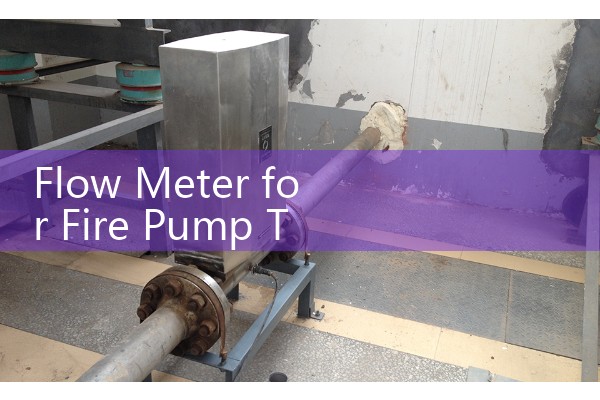
Venturi vs Electromagnetic vs Ultrasonic
A Venturi meter is low cost for large pipes. But it needs a DP transmitter, impulse lines, and careful zeroing. An electromagnetic flow meter is more accurate and easier to maintain. A clamp-on ultrasonic meter is portable. It can work for spot checks. In noisy pump rooms, clamp-on ultrasonic can lose signal. For permanent NFPA 20 test loops, most contractors in Southeast Asia and the Middle East now use electromagnetic flow meters from Silver Instruments.
Installation Tips for NFPA 20 Compliance
Keep the meter full of water during the test. Remove air from the line. Air bubbles cause reading errors. Grounding is critical for electromagnetic flow meters. Use grounding rings on plastic or lined pipe. If you use a Venturi meter, install the pressure taps at the correct location. Slope the impulse lines so air does not collect. Do not install the meter in a partially filled pipe. Calibrate the meter once per year. Keep test records for the fire marshal or insurance surveyor.
We have supplied flow meters for fire pump test skids in Indonesia, the UAE, and Vietnam. One fire pump OEM in Dubai asked for a DN150 electromagnetic meter with IP68 sensor and HART output. Their test trailer needed a compact footprint. The meter replaced a Venturi that had a 15D upstream requirement. The new skid now fits in a 6 meter trailer.
FAQ
Which flow meter does NFPA 20 require for fire pump testing?
NFPA 20 does not name one flow meter type. It requires a calibrated flow meter in the test loop. Venturi, electromagnetic, and ultrasonic meters are all acceptable when the straight pipe and calibration are correct.
What is the minimum straight pipe for a Venturi flow meter in a fire pump test line?
Most installers use 10 pipe diameters upstream and 5 pipe diameters downstream. Some Venturi manuals require 15D upstream for high beta ratios. Check the meter manual and the test loop drawing.
Can I use a clamp-on ultrasonic flow meter for NFPA 20 fire pump tests?
Yes, but clamp-on ultrasonic meters can fail in noisy pump rooms. Electromagnetic meters give a more stable reading on hard pipe. They are the preferred choice for permanent test loops.
What size electromagnetic flow meter fits a fire pump test header?
The size depends on your flow range. Common sizes are DN100, DN150, and DN200 for pumps from 500 to 5000 liters per minute. We can review your pump curve and test loop P and ID before quoting.
How often should flow meters be calibrated for fire pump testing?
A yearly calibration is normal. Some fire pump service companies calibrate before each annual test. Send your current meter model and test data. We can advise if a repair or replacement is needed.
Send Your Fire Pump Test Loop Data
Tell our engineers your pipe size in DN, pressure in bar, temperature in degrees C, and flow range in cubic meters per hour. We will recommend a flow meter that fits your NFPA 20 test loop and Venturi pipe spacing. Contact Silver Automation Instruments. Tel: +86-25-68650347. Whatsapp: +86-25-52155837. WeChat: +86 15365082610.
 Hot Product
 Related AD