

『Jet Fuel Flow Meter 1/2 Inch: Perfecting Flow Measurement on Test Stands』Related information(v cone flow meter|rotary gas meter|gallon meter|gear meter|metal tube rotameter|glass tube rotameter|nutating disk meter|transit time ultrasonic flow meter|wedge flow meter|pd meters|hydraulic flow meter|ultrasonic water flow meter|water flow meter|air flow meter|magnetic water flow meter|oxygen flow meter|gas flow meter|argon flow meter|air velocity meter|gasoline flow meter|fuel flow meter|ultrasonic water meter|digital water meter|nitrogen flow meter|solid flow meter|Oxygen tank flow meter|digital water flow meter|diesel fuel flow meter|steam flow meter|02 flow meter|compressed air flow meter|oil flow meter|liquid flow meter)
Jet Fuel Flow Meter 1/2 Inch: Perfecting Flow Measurement on Test Stands
Quick Answer: A 1/2 inch jet fuel flow meter on a test stand needs accuracy better than ±0.5% of reading, fast response to flow changes, and full compatibility with Jet A-1 or JP-8. Silver Automation Instruments supplies turbine and Coriolis meters in DN15 size that meet these demands without frequent recalibration drift. For a quote on a meter matched to your test stand operating pressure and temperature, send us your full flow range, pipe connection type, and fuel type.
Why a Dedicated 1/2 Inch Meter Wins on Fuel Test Stands
Jet fuel test stands are not like process lines in a refinery. Here you measure flows from a few liters per hour up to maybe 2000 L/h, often at elevated temperatures and with abrupt start-stop cycles. A general-purpose flow meter rarely survives this for long. A 1/2 inch meter built for low to medium viscosity hydrocarbons gives you repeatable numbers run after run.
Most engine test cells, fuel pump calibration rigs, and fuel nozzle spray benches use a DN15 pipe size. That matches a 1/2 inch flow meter directly. No reducers, no extra pressure drop, no dead volumes that trap air. Silver Instruments has supplied meters into exactly this setup for an independent jet engine overhaul shop in Malaysia and a fuel pump manufacturer in Turkey. Their feedback shaped the selection logic we share below.
Meter Technology That Holds Up to Jet Fuel
Turbine flow meters remain the workhorse for jet fuel on test stands. A 1/2 inch turbine from our SIT-015 series gives you a turndown of 10:1 or better, frequency output proportional to flow, and an accuracy of ±0.5% of reading after linearization. Because jet fuel has a viscosity around 1.5 to 2 cSt at 20°C, the turbine bearings must be hard-coated. We use a tungsten carbide shaft and sleeve bearing pair. This prevents the hang-up that occurs when fuel sits in the meter between tests and leaves a thin varnish.
Coriolis mass flow meters are gaining ground. Our SIC-008 model, also in 1/2 inch size, measures mass flow directly. You do not need to compensate for density changes when the test stand moves from Jet A-1 to a synthetic fuel blend. The dual bent-tube design handles fuel temperatures up to 150°C, which covers the preheated fuel scenarios common in turbine component testing. One customer in Brazil runs the SIC-008 at 120°C inlet temperature and gets mass flow repeatability of ±0.1% across a 24-hour durability test. That sort of stability matters when you sign off on engine fuel system performance.
Installation Details Most Engineers Skip
Here is the thing. A 1/2 inch meter on a test stand often gets mounted right after a positive displacement pump. That pump creates pressure pulsations that a turbine meter reads as flow noise. In practice, if you do not install a pulsation dampener or an air chamber upstream, your flow data will show spikes that do not exist. We have seen this on customer sites many times. A simple diaphragm-type dampener, placed 10 pipe diameters before the meter, cleans up the signal dramatically.
Another point is air elimination. Jet fuel picks up entrained air when it returns to an open tank. In a closed-loop test stand, that air collects in the high point. A 1/2 inch line makes the problem worse because small air bubbles occupy a bigger fraction of the pipe cross section. Install an automatic air vent just upstream of the flow meter. The cost is low. The improvement in measurement consistency is high.
Signal Integration and Data Logging
Test stands rarely run standalone. They feed data into a PLC or a dedicated DAQ system. Our 1/2 inch meters come with a choice of outputs: raw frequency, 4-20 mA analog, or RS485 Modbus. For high-speed data capture, frequency output is the way to go. When a test stand ramps fuel flow from idle to full power in under two seconds, you need a meter that can output pulses at up to 2000 Hz without saturation. The Silver Instruments turbine electronics board refreshes the pulse output every 0.2 ms, so no dead time masks the transient.
If your test stand uses a paperless recorder or a PLC with analog input, specify the 4-20 mA output with HART. The HART signal allows you to read not only flow rate but also a secondary variable, like meter temperature. This is useful for diagnostics. A sudden temperature rise at the meter body can indicate a cavitation event downstream of the control valve. We have helped a diesel injector test lab in Vietnam set up exactly this alarm logic.
When to Choos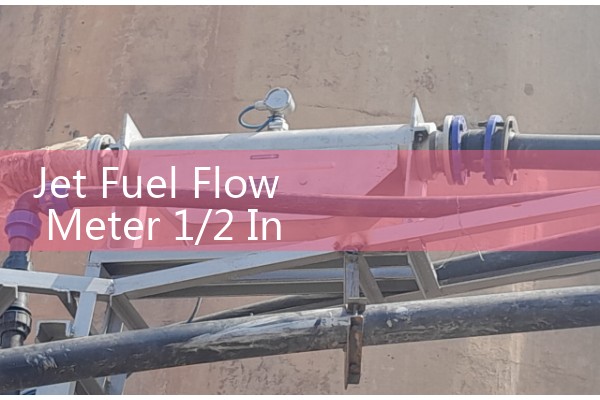
Oval gear positive displacement meters in 1/2 inch size offer an alternative. Our SIF-012 oval gear meter handles flows down to 0.5 L/h. This is a niche but important requirement in small flow nozzle testing or when measuring pilot burner fuel circuits. The oval gear meter is immune to viscosity changes, so if your test stand handles jet fuel with cold flow improvers or wide temperature swings, the meter output remains linear. The trade-off is higher pressure drop and a need for fine filtration, typically 40 microns upstream strainer. A lab in South Africa testing fuel atomizers on a micro flow stand uses two SIF-012 meters in parallel, one for the main flow and one for the bypass return line. They calculate net fuel to the nozzle by subtraction.
Calibration and Traceability
On a test stand, traceable calibration is non-negotiable. Every 1/2 inch flow meter we ship for jet fuel service gets a 5-point calibration using a master meter traceable to ISO 17025 standards. The calibration fluid is MIL-C-7024 type II or a close substitute with a density matching Jet A-1. You receive a calibration certificate stating the K-factor at each flow point. If you operate the meter at a temperature far from the calibration temperature, ask for a hot calibration run. We can calibrate up to 80°C in our flow lab. A customer in the UAE doing engine fuel system certification needed exactly that. The hot K-factor shifted by 0.2% from the cold value due to thermal expansion of the rotor. Having that number on the certificate saved them weeks of in-house verification.
Common Failure Modes and How to Avoid Them
We see three main failures with 1/2 inch jet fuel meters on test stands. One is bearing seizure after a long shutdown, caused by dried fuel residue. Flush the meter with a solvent like isopropyl alcohol after each test day if possible. Two is electrical noise from a variable frequency drive that sits close to the meter cable. Use shielded twisted pair cable and keep the run below 30 meters. Three is over-speeding the turbine when a bypass valve opens suddenly and slams full line pressure onto the meter. Install a flow limiter or an orifice plate upstream to cap the maximum velocity. These are low-cost fixes that prevent expensive recalibration or replacement.
Frequently Asked Questions
Which 1/2 inch flow meter works best for Jet A-1 with 5% biodiesel blend?
A turbine meter with carbide bearings, like our SIT-015, works well. Biodiesel blends up to 5% do not change viscosity enough to throw off the K-factor beyond 0.1%. For higher blends, a Coriolis meter avoids density and viscosity uncertainty entirely.
Can I use the same meter for calibration fluid and actual jet fuel without recalibration?
Yes, if the calibration fluid density matches Jet A-1 within 2%. A Coriolis meter is unaffected by fluid type. A turbine meter will show a small offset, typically less than 0.3%, which you can correct with a single-point adjustment in your data system.
What is the maximum pressure rating for a 1/2 inch meter in a test stand?
Our standard 1/2 inch turbine and Coriolis meters are rated for 40 bar (580 psi) at ambient temperature. For higher test pressures, we offer a 100 bar option with a heavier body and all-welded construction. Tell us your maximum operating pressure when you request a quote.
How do I prevent air bubbles from ruining my test data?
Install an automatic air vent directly upstream of the meter, maintain a slight back pressure of at least 1 bar at the meter outlet, and avoid splashing return fuel in the tank. A vortex eliminator in the tank helps if nitrogen pressurization is used.
What flow range can I expect from a 1/2 inch jet fuel flow meter?
In turbine type, typical range is 2 to 20 L/min for Jet A-1 at 20°C. A Coriolis meter covers 0.5 to 15 L/min with higher accuracy at the low end. For flow below 0.5 L/min, an oval gear meter is the better pick. Send us your minimum and maximum flow targets, and we will recommend the specific model.
Ready to specify a meter for your test stand? Send us your fuel type, flow range in L/h or kg/h, operating pressure in bar, and temperature in °C. Mention your pipe connection preference, NPT or BSPP, and output signal needed. Our engineers will return a complete data sheet and price for the 1/2 inch meter that fits your test stand without compromise. Reach out via the quote form on flow-meter.com.au or email directly.
 Hot Blog
 Related AD