

 Current position > News detail
『Hose End Water Flow Meter: Portable Digital Outdoor Irrigation Gauges』Related information(v cone flow meter|rotary gas meter|gallon meter|gear meter|metal tube rotameter|glass tube rotameter|nutating disk meter|transit time ultrasonic flow meter|wedge flow meter|pd meters|hydraulic flow meter|ultrasonic water flow meter|water flow meter|air flow meter|magnetic water flow meter|oxygen flow meter|gas flow meter|argon flow meter|air velocity meter|gasoline flow meter|fuel flow meter|ultrasonic water meter|digital water meter|nitrogen flow meter|solid flow meter|Oxygen tank flow meter|digital water flow meter|diesel fuel flow meter|steam flow meter|02 flow meter|compressed air flow meter|oil flow meter|liquid flow meter)
Hose End Water Flow Meter: Portable Digital Outdoor Irrigation Gauges
Quick Answer: A hose end water flow meter gives you instant readings of flow rate and total volume directly at the nozzle or tap. Silver Automation Instruments supplies portable digital models that screw onto any standard garden hose thread, measure from 2 to 60 L/min, and run on a coin battery for a full irrigation season. No electrician, no control panel, just twist it on and start tracking water use in litres or gallons.
Farmers in Malaysia, golf course managers in Oman, and nursery operators in Chile have one problem in common. They need to know exactly how much water goes onto each zone. A fixed inline flow meter often costs too much, takes time to install, and needs wiring. A hose end meter solves that in five seconds. You remove the guesswork from hand watering, drip line testing, and sprinkler checks.
What a hose end flow meter actually measures
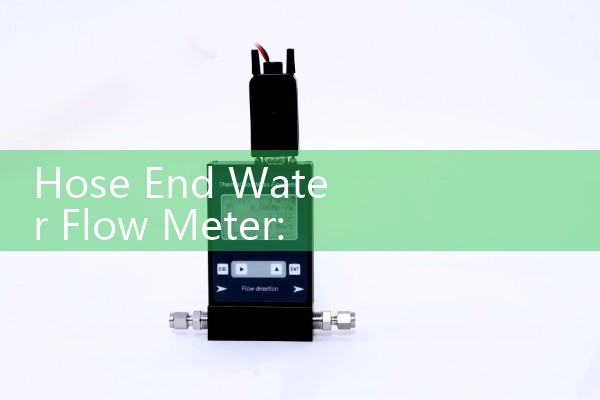
This kind of meter sits between your hose bib and the hose itself. Inlet is usually a 3/4 inch female garden hose thread (GHT). Outlet is the same male GHT. Inside, a small turbine or paddle wheel spins as water passes. A Hall effect sensor counts the revolutions. The onboard chip converts the pulses into flow rate and accumulated total. You read the numbers on a small LCD screen, often protected by a splash proof cover. That is the whole principle. No 4-20 mA output, no HART, no RS485. Just a local digital display that resets with one button.
Silver Instruments stocks a rugged version made of engineered ABS with a brass insert at the inlet. The O-ring at the connection is NBR, suitable for fresh water and non potable irrigation water. For treated wastewater or slightly acidic well water, we can supply an EPDM O-ring as a small spare part. Always tell your sales contact the water source when you order.
Why a portable digital meter beats a mechanical dial
You have probably seen the brass bodied mechanical water meters with a dial and pointer. They work. But they do not show flow rate. You have to time a bucket and do the maths. A digital hose end meter gives you both instant flow (L/min or GPM) and total volume (litres or gallons) on the same screen. Most models from Silver Instruments update the reading every 3 to 5 seconds. That is fast enough to adjust a ball valve while watching the numbers change in real time.
Another detail engineers notice straight away. Mechanical meters can jam if there is fine sand or biofilm. The digital turbine type we offer has a removable strainer at the inlet. A 60 mesh stainless steel screen catches particles above 250 micron. You unscrew the transparent cover, rinse the screen under a tap, and reassemble in under a minute. In practice, a flower farm in Kenya that uses river water cleans the strainer every two weeks during the dry season. That small routine keeps the meter accurate within ±2% of reading.
Typical specs that matter on a job site
We talk a lot about DN15 to DN200 on the factory floor, but for hose end devices the sizing is simpler. The standard connection is 3/4 inch BSP or GHT. Flow range starts as low as 2 L/min and tops out around 60 L/min. Pressure rating is usually 8 bar at 20 °C. Maximum water temperature is 40 °C for the standard version. If you need to measure hot water from a solar heater drain line, we recommend our inline mini turbine flow meter with PT100 temperature sensor instead, because the hose end model seals can soften above 50 °C.
Power comes from a CR2032 lithium cell. It lasts roughly 12 months with daily use of two hours. The display turns off automatically after 60 seconds of no flow. When you open the tap again, the electronics wake up and keep the previous total in memory. So you do not lose the accumulated volume for the day.
Where these meters appear in the field
We have shipped these to a date palm plantation in Saudi Arabia. They use ten meters on mobile hose carts. Each cart waters 50 trees per shift. The operator notes the total per tree and moves to the next. Because the meter is portable, the same unit can be swapped between different blocks without any mounting bracket. Just unscrew and attach to the next standpipe.
In Australia, landscape contractors use the digital hose end meter to test the output of pop up sprinklers. They thread it onto a riser, run the zone for 60 seconds, and read the flow. That tells them immediately if a nozzle is worn or a lateral line has a crack. A sudden jump from 8 L/min to 15 L/min on the same circuit means a leak somewhere downstream. Beats chasing puddles with a shovel.
Vegetable tunnel houses in Thailand rely on these to control fertigati
Common misapplications and how to avoid them
Do not use a hose end meter on a pump suction line. These are positive displacement or turbine devices designed for discharge pressure, not vacuum. The bearings can pull out of alignment under negative pressure. Same rule applies to gravity fed systems with less than 0.3 bar inlet pressure. The turbine needs a minimum of 0.5 bar to overcome inertia. If you only have gravity head from a raised tank, consider an oval gear flow meter instead. It spins at much lower pressures and handles viscous liquids if you ever switch to liquid feed supplements.
Another trap is backflow. A hose end meter is not a backflow prevention device. If you inject fertilizer upstream, install a separate check valve or an antisiphon device as required by local plumbing codes. For irrigation systems connected to potable supply in the Middle East, local authorities often mandate a reduced pressure zone (RPZ) valve upstream of any injection point. The meter just measures, it does not protect.
Accuracy in the real world, not the lab
The brochure claims ±1% or ±2% of reading. Here is the thing. That number assumes clean water, 20 °C, fully developed flow profile, and no air bubbles. On an actual garden hose coming from a shallow well, you might see air slugs after the pump cycles. The impeller spins faster when it hits an air pocket, and the totalizer can creep up by 3% to 5% during a watering session. To reduce this error, we suggest a short straight run of pipe upstream. Even 15 cm of rigid PVC or a brass nipple before the meter inlet will straighten the flow and let air escape before it reaches the turbine. A simple trick that most engineers skip.
For applications where you bill customers by the cubic metre, do not use a hose end meter as your fiscal meter. It is not MID or OIML certified. Use it as a check meter or a field indicator. If you need billing accuracy, our electromagnetic flow meters with the appropriate certificate are the right tool. We can guide you through the documentation for a water utility in Peru or a drilling company in Nigeria.
Silver Instruments recommendation matrix
Ask yourself these three questions before choosing a model:
What is the minimum pressure at the tap? (Need 0.5 bar or more?)
What is the maximum flow? (Stick to 2–60 L/min range)
Do you need a data output? (No, it is local display only)
If your answers are yes, within range, and no data needed, the portable digital hose end meter fits. Model number is SEM-H-075. It covers 95% of garden hose and small irrigation pipe applications up to 25 mm OD poly pipe with a simple barb adapter. We keep stock in our warehouse and ship to over 40 countries via DHL or sea freight.
FAQ
Q: Can this meter handle dirty pond water?
A: Only if you use the built in strainer and clean it often. For water with silt above 500 ppm, we recommend an inline magnetic flow meter with no moving parts.
Q: Does it work upside down or sideways?
A: Orientation does not affect accuracy because the turbine is axial. Most users mount it horizontally on a tap, but vertical is fine too.
Q: Can I replace the battery myself?
A: Yes. Open the waterproof cover with a coin, swap the CR2032, and apply a thin layer of silicone grease on the O-ring before closing.
Q: What thread standard is the meter?
A: Standard stock is 3/4 inch GHT (garden hose thread). We also supply BSP threads for the UK, Australia, and parts of Southeast Asia. State your country when ordering.
Q: Is the display backlit?
A: No backlight on this model. In low light, use a headlamp or choose our hose end meter with an IP68 rated display if you work at night.
Send us your pressure (bar), temperature (°C), pipe size (DN), and flow range to get the right portable meter or a fixed irrigation flow meter that matches your setup. Reach our engineers at [email protected], call +86-135-1213-1526, or message via WhatsApp at 86-135-12131526. WeChat users add +86 13512131526. Silver Automation Instruments ships direct to end users and distributors in Southeast Asia, Oceania, Latin America, Africa, and the Middle East.