

 Current position > News detail
『Flow Meter 2 Inch Sizing: Choosing Between Turbine, Vortex, and Electromagnetic Models』Related information(v cone flow meter|rotary gas meter|gallon meter|gear meter|metal tube rotameter|glass tube rotameter|nutating disk meter|transit time ultrasonic flow meter|wedge flow meter|pd meters|hydraulic flow meter|ultrasonic water flow meter|water flow meter|air flow meter|magnetic water flow meter|oxygen flow meter|gas flow meter|argon flow meter|air velocity meter|gasoline flow meter|fuel flow meter|ultrasonic water meter|digital water meter|nitrogen flow meter|solid flow meter|Oxygen tank flow meter|digital water flow meter|diesel fuel flow meter|steam flow meter|02 flow meter|compressed air flow meter|oil flow meter|liquid flow meter)
Flow Meter 2 Inch Sizing: Choosing Between Turbine, Vortex, and Electromagnetic Models
Quick Answer: For most 2 inch water and wastewater lines, choose an electromagnetic flow meter. For clean fuels and oils with stable flow, a turbine meter works well. For steam or gas at DN50, choose vortex. The final selection depends on conductivity, pressure, temperature, and minimum flow rate.
Silver Automation Instruments supplies DN50 flow meters with pulse, 4-20 mA, HART, and RS485 outputs. We help industrial users in Southeast Asia, Latin America, Africa, the Middle East, and Oceania.
Why 2 Inch Flow Meter Sizing Starts With Pipe Data
A 2 inch line is DN50 in most process plants. Actual inside diameter changes with pipe schedule. Schedule 40 stainless steel pipe has an inside diameter around 52.5 mm. Cross section is about 0.00216 square meters. Flow at 1 m/s equals about 7.8 m3/h. That means a DN50 meter with a range of 1 to 40 m3/h covers many utility and batch services.
Most engineers skip one step. They look at line size only and ignore minimum flow. A 2 inch meter sized for 30 m3/h cannot read 0.3 m3/h reliably. We have seen this on customer sites many times in Vietnam, Indonesia, and the Philippines.
Send us the fluid name, viscosity in cP, pressure in bar, temperature in degree C, and min max flow in m3/h or kg/h. We will check velocity and Reynolds number before quoting.
Turbine Flow Meter on a 2 Inch Line
A turbine meter uses a rotor. It is good for clean water, diesel, light oil, and solvents. Accuracy is often 0.5 percent of reading. A DN50 turbine meter usually covers 2 to 40 m3/h for water. Outputs include pulse, 4-20 mA, and HART.
Turbine meters do not like particles. Install a strainer upstream if the fluid has sand or rust. The bearing wears quickly in dirty service. Viscosity above 10 cP shifts the meter curve. We supplied a 2 inch turbine meter to a diesel generator OEM in Nigeria last year. The fluid was clean, so bearing life was good.
Vortex Flow Meter on a 2 Inch Line
A vortex meter has no moving parts. It handles steam, compressed air, natural gas, and clean liquids. For a 2 inch line, vortex is the only choice among these three if the fluid is gas or steam.
Minimum flow varies with density. Do not size a DN50 vortex meter for very low gas flow. A food plant in Thailand uses a DN50 vortex meter on a 2 inch steam line for jacketed kettles. The meter gives mass flow with temperature and pressure compensation. No moving parts means less maintenance than an orifice plate.
Electromagnetic Flow Meter on a 2 Inch Line
An electromagnetic meter requires conductive liquid. Minimum conductivity is about 5 µS/cm for many models. Use 20 µS/cm as a safer limit. The meter works for water, wastewater, chemicals, slurries, pulp, and food fluids. It has no moving parts and nearly zero pressure drop.
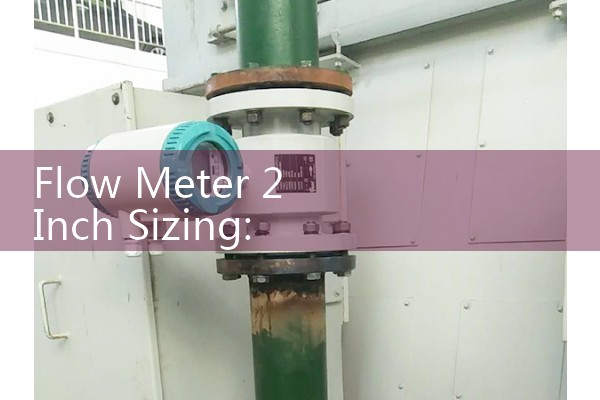
A DN50 electromagnetic flow meter covers about 0.5 to 40 m3/h. It reads low flow better than turbine or vortex. Liners include PTFE, hard rubber, and polyurethane. Electrodes include 316L, Hastelloy, titanium, and tantalum. A water treatment contractor in Indonesia replaced a 2 inch turbine meter with an electromagnetic meter because raw water had fine sand. The turbine bearing failed in four months. The electromagnetic meter has run two years without maintenance.
Compare the Three Models for a 2 Inch Application
For clean water with light particles and a limited budget, turbine is the lowest cost. For steam or gas, only vortex applies. For conductive liquids with solids or low flow, electromagnetic is the best choice. Pressure drop is highest for turbine and vortex. Electromagnetic pressure drop is close to zero.
Price order for DN50 models at Silver Automation Instruments is usually turbine first, vortex second, electromagnetic third. But if you add a strainer and bearing replacement to a turbine meter, the total cost changes. Here is the thing. A dirty water line often costs less over five years with an electromagnetic meter.
Which Flow Meter Do We Recommend for Common 2 Inch Services
Raw water, well water, wastewater, chemical dosing, and food slurry: choose electromagnetic.
Diesel, light oil, clean water with no solids, and batch delivery: choose turbine.
Steam, compressed air, natural gas, and boiler fuel gas: choose vortex.
What to Send for a Quote
Tell us your fluid, conductivity in µS/cm, viscosity in cP, flow range in m3/h or kg/h, pressure in bar, temperature in degree C, pipe schedule, and hazardous area classification. Tell us if you need ATEX Zone 1 or Zone 2 certification. Send the details to Silver Automation Instruments.
Tel: +86-25-68650347
Whatsapp: +86-25-52155837
WeChat: +86 15365082610
Website: flow-meter.com.au
We reply within 24 hours.
FAQ
Can a 2 inch electromagnetic flow meter measure drinking water? Yes. Drinking water conductivity is high enough. Use a PTFE or rubber liner and 316L electrodes.
Can a turbine meter handle diesel with viscosity 4 cP? Yes. 4 cP is fine. Accuracy may shift slightly above 10 cP.
What is the minimum flow for a DN50 vortex meter on compressed air at 7 bar? It depends on pressure and temperature. Send us operating conditions. We size the meter from density, velocity, and Reynolds number.
Do I need straight run for a 2 inch electromagnetic meter? Yes. Typical straight run is 5D upstream and 2D downstream. Some models with grounding rings can handle 3D upstream. Follow the installation manual.
Which meter is best for 2 inch sodium hydroxide 20 percent? Use an electromagnetic meter with PTFE liner and Hastelloy electrodes. Sodium hydroxide is conductive and can corrode some metals.